Black Friday and Beyond: Sales and Promotions on Darknet Marketplaces
November 25, 2026
Black Friday is one of the most recognizable fixtures of the legitimate retail calendar. Weeks before the event, stores announce discounts, launch limited-time campaigns, and compete for attention with familiar language about deals, markdowns, and urgency. Darknet marketplace vendors borrow from the same playbook. Yet an analysis of sale-related listings shows that Black Friday is only a small part of a wider promotion culture, one in which seasonal campaigns, generic sale language, bulk pricing, and discounts that never seem to end coexist across the market. Seasonal events accounted for about one in seven of the campaign-style promotions examined in detail. Even during November and December 2025, when Black Friday and Christmas promotions were most likely to appear, the figure reached only about one in four. Black Friday is therefore less an exceptional event than a visible expression of a broader, always-on promotional system.
Black Friday Comes to the Darknet
In November 2025, darknet marketplace listings displayed something surprisingly close to a conventional Black Friday campaign. 37 new listings carrying Black Friday language first appeared during the month, out of 67 over the whole period studied. Activity began building weeks before Black Friday on November 28, and the busiest period was November 10-16, nearly two weeks before the event itself.
The campaigns were not always isolated product promotions. On November 13, one vendor posted 7 listings bearing the same Black Friday sale format within eight minutes. The listings covered cocaine, methamphetamine, ketamine, MDMA, and 2-MMC. Another vendor applied the same Black Friday wording to multiple package sizes of a cocaine listing. In both cases, the sellers appeared to be rolling out coordinated campaigns across several products or variants rather than advertising a single discounted item.
Across the market, Black Friday titles covered cocaine, benzodiazepines, MDMA/XTC, other stimulants, and pharmaceuticals including Xanax, pregabalin, diazepam, and tramadol. The variety suggests that Black Friday language was not confined to one product class or seller niche.
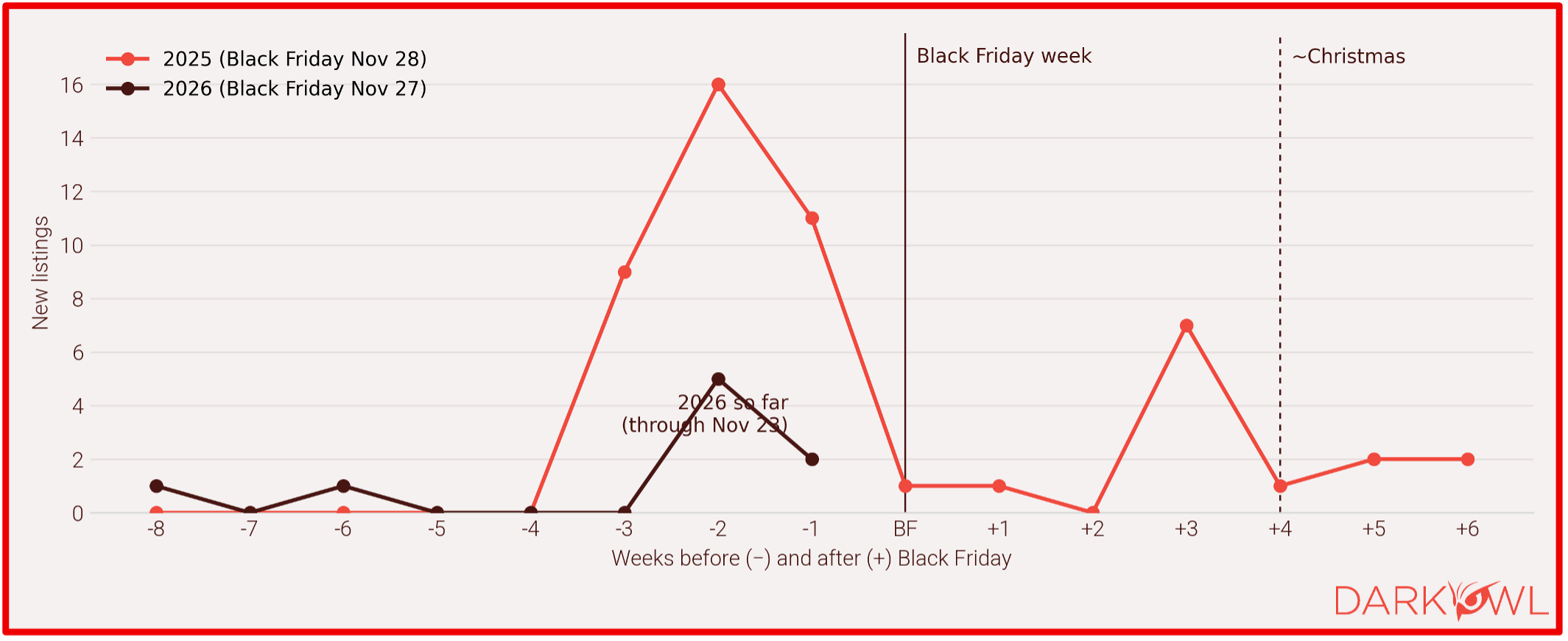
Activity in 2026 has started to pick up, but not at the same pace. Through November 23, four days before Black Friday on November 27, seven new listings with Black Friday or Thanksgiving wording had appeared in November: an “EARLY BLACK FRIDAY DEALS” cocaine listing posted on November 17 and again on November 18, two cannabis sample or promo packs, prescription dextroamphetamine and oxycodone listings, one advertising “100 Dollars Off,” and a methamphetamine listing wishing buyers a happy Thanksgiving. By the same point in 2025, 28 had already appeared. The 2026 campaign may still build in the final days, but so far it is running at roughly a quarter of the previous year’s pace. That contrast prompted a broader question:
Is Black Friday unusual, or is it simply one part of a much larger promotional culture on darknet marketplaces?
What Counts as a Sale?
To examine that question, the analysis expanded beyond Black Friday to listing snapshots whose titles or descriptions contained language associated with sales, discounts, promotions, or seasonal events. The dataset included 22,233 listings first observed between August 1, 2025 and November 23, 2026.
A listing containing the word “sale,” however, is not necessarily advertising a discount. In fact, 12,923 of the 22,233 candidate listings (58%) were not advertising a discount at all. The remaining 9,310 (42%) represented an identifiable seasonal sale, promotion, or standing discount. The 12,923 non-sale listings included phrases such as “for sale,” “wholesale,” “1,000+ sales,” and “all sales final.” These uses describe availability, order volume, or seller policies rather than a temporary price incentive.

This distinction matters for threat intelligence and marketplace research. A broad search for “black” followed by “friday” matched 165 listings in the analysis period, but only 67 were actually about Black Friday. Most of the others came from unrelated boilerplate, including warnings that customers could be blacklisted and statements that orders shipped Monday through Friday. Proximity-based matching and classification were needed to separate genuine promotions from incidental keyword overlap.
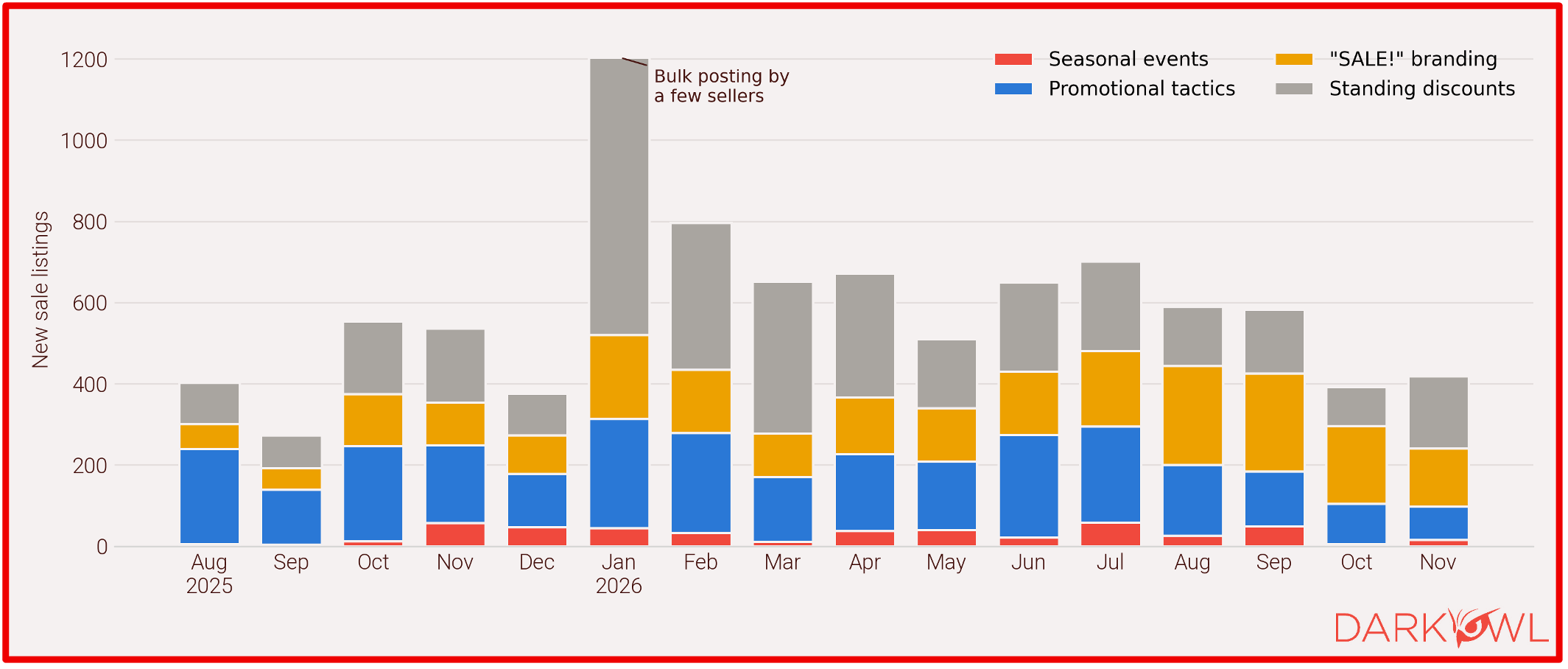
The 9,310 sale listings fell into four mutually exclusive tiers: 469 seasonal events, 2,940 promotional tactics, 2,344 listings using generic “SALE!” branding, and 3,557 standing discounts. The analysis that follows focuses primarily on the 3,409 listings in the first two groups. Seasonal events accounted for about one in seven of these campaign-style promotions (13.8%), rising to about one in four in November 2025 (23%) and December 2025 (26%). Generic “SALE!” wording and standing discounts are discussed briefly in section 4.
Seasonal Sales: A Loose Retail Calendar
Darknet vendors draw from a surprisingly broad retail calendar. Seasonal listings referenced Christmas and other winter holidays, Black Friday, spring, summer, autumn, New Year, Easter, Valentine’s Day, 4/20, Halloween, July 4, and vendor or market anniversaries. As in legitimate ecommerce, recognizable occasions give sellers a ready-made reason to advertise existing inventory and encourage buyers to act.
Christmas or holiday wording formed the largest seasonal category, with 137 listings, followed by spring sales (95), summer sales (77), and Black Friday or Cyber Monday (67). Black Friday showed the strongest alignment with its expected window: 46 of its 67 listings (69%) appeared on time or early. Autumn and winter promotions were even more punctual (40 of 44, or 91%), but most other events were considerably less disciplined.
Each season also had its own product mix. Christmas listings were dominated by cocaine (40) and heroin (15); spring sales by weed and heroin; summer sales by LSD, ketamine, cocaine, and XTC; and Black Friday by cocaine, benzodiazepines, and MDMA/XTC.
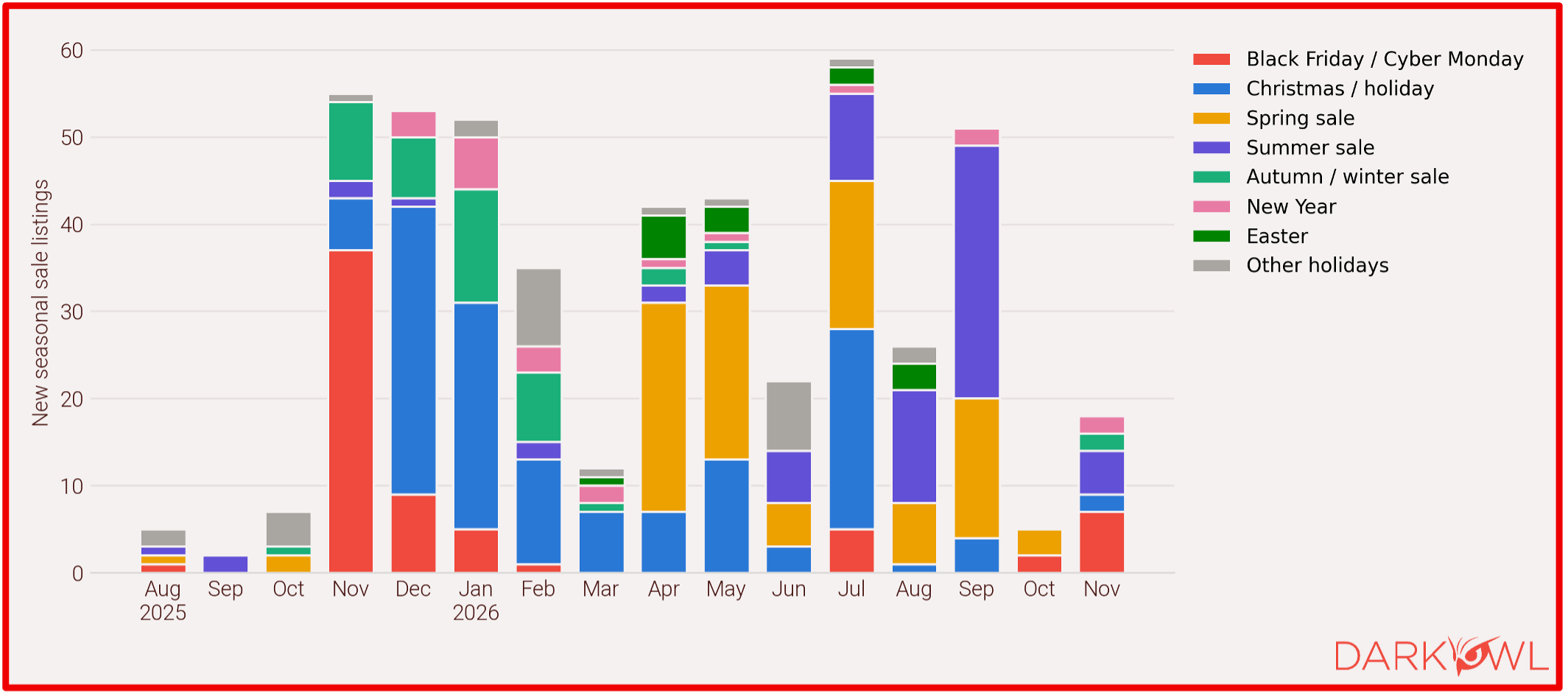
Smaller holidays rarely represented market-wide events. New Year sales were small but genuine: 21 listings, most first seen between December 29 and late January. Easter activity was driven largely by one vendor’s multi-product campaign. The remaining events, grouped as “Other holidays” in Figure 3, barely registered: most 4/20 matches came from non-cannabis listings carrying shared boilerplate, and Valentine’s Day, Halloween, July 4, and a vendor-anniversary sale produced only a handful of listings each. These examples show how a small number of sellers or reused templates can create the appearance of broader seasonal activity.
Out of Season: Christmas in July and Spring in September
Christmas-related listings peaked in December 2025 and January 2026, as expected, but another 23 first appeared in July 2026. Some of this may be borrowed retail timing: 14 of the 23 appeared on July 28 and 29, just after the traditional July 25 date of mainstream “Christmas in July” promotions.
Listing reuse explains much of the rest. Titles such as “XMAS SALE!! – AAA+++ COLOMBIAN / PERUVIAN / BOLIVIAN COCAINE” kept appearing long after the holiday, and spring promotions continued into September through reused titles such as “SYNTHETIC CHINA WHITE … | SPRING SALE!” Vendors copy older listings, reuse titles across package sizes, or leave promotional wording unchanged, so what began as a time-limited campaign can become part of a listing’s permanent identity. Holiday phrases on their own are not evidence of a timely, intentional campaign.
Promotions Run All Year
Seasonal events are the most recognizable form of sale, but they are not the dominant one. The 469 seasonal-event listings were outnumbered more than six to one by 2,940 promotional tactics with no event attached, and another 2,344 listings used generic “SALE!” wording on its own.
“SALE!” as branding (2,344). Generic wording such as “MEGA SALE” (435), “SALE!” (407), “BIG SALE” (353), “SUPER SALE” (244), and “CRAZY SALE” (136) appeared most often for ketamine, XTC, cocaine, and weed. The wording rarely signals a clearly time-limited campaign and often persists for months, a pattern examined in more detail below.
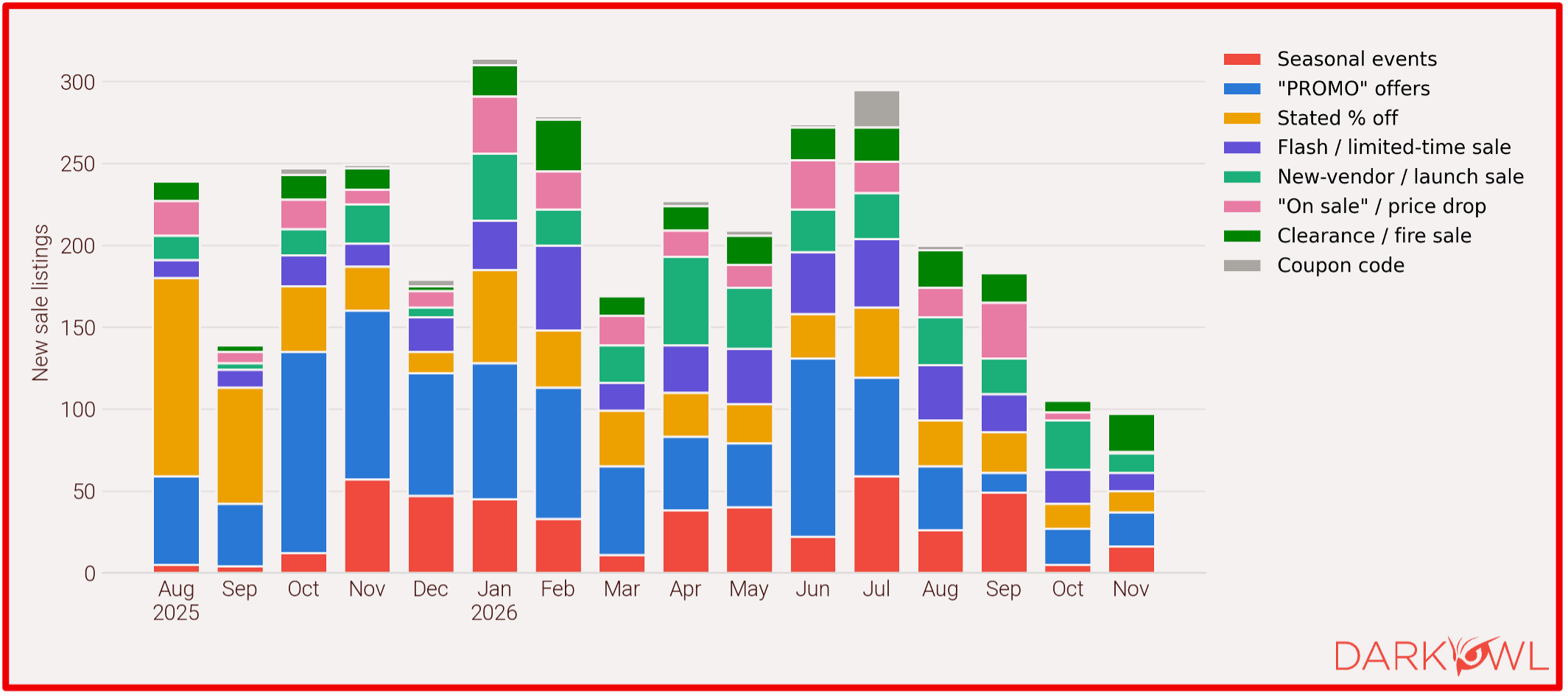
The 2,940 promotional tactics break down as follows:
- “PROMO” offers (957). Introductory or bundled offers rather than stated price cuts, and highly concentrated: 357 of the 957 (37%) share one “… PROMOSALE & FASTSHIP” title template, and another 156 carry one vendor’s promise of “free bonus pills” to “start spreading our name.”
- Percentage off (600). Most stated discounts are modest: of the 577 that state a number, 319 offer 10% off, and 227 of those 319 are card-fraud listings selling CVVs, cards, and dumps.
- Flash and limited-time sales (407). Led by weed (61) and cocaine (45). Here the urgency is the pitch rather than the price: flash-sale listings were priced at the typical level for the same product and size, and 47 of the 407 kept their “limited time” wording for 90 days or more.
- Launch and new-vendor sales (389). Discounts that buy reputation for a seller with few reviews, appearing every month and led by Adderall (65).
- Smaller tactics (587). The remaining 587 were split among “on sale” price drops (278), clearance and fire sales (255), and coupon codes (54).
Are the Discounts Real?
The price evidence is preliminary, because relatively few listings could be matched to comparable non-sale listings. Against non-sale listings of the same product and size, PROMO and clearance listings were both priced a median 21% below the typical price (246 and 33 matched listings), while flash-sale listings were not cheaper at all (99), suggesting that some promotions reflect real reductions while urgency and sale language often do not.
Sales that Never End
Scarcity and urgency are central to a conventional promotion: the sale matters because it ends. On darknet marketplaces, many sales become effectively permanent. Of the 3,409 promotions, 607 kept their sale wording for at least 90 days (87 seasonal and 520 promotional tactics), as did 411 of the 2,344 generic “SALE!” listings. These are minimums, because duration can only be measured for listings observed more than once (1,331 of the 3,409 promotions); among those, the median promotional tactic kept its wording for 75 days. Some of this is evergreen marketing, where “sale” is simply part of the product’s pitch; some is stale wording from a genuine short-term promotion that was never removed, the same reuse seen with Christmas in July. Either way, promotional wording on its own is not evidence of a current price reduction.
Standing Discounts: the Always-On Offer
Standing discounts are a different kind of offer and are not the focus of this report, but they are common: 3,557 listings, split between bulk or volume pricing (1,655), general “discounted prices” or next-order discounts (1,883), and repeat-customer offers (19). They do not depend on a date or event; the seller uses price to encourage larger or repeat orders. Xanax, methamphetamine, and oxycodone are the most common products, along with smuggled cigarettes and money-transfer services that rarely appear in other listings.
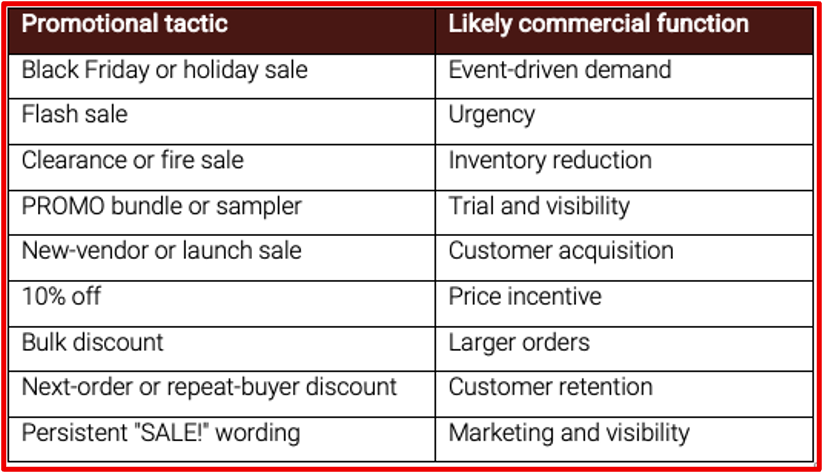
Together, these tactics map onto familiar commercial goals:
What Promotions Reveal About Vendor Behavior
The products and platforms differ dramatically from legitimate ecommerce, but many of the underlying sales tactics do not. Darknet vendors use Black Friday campaigns, holiday promotions, percentage markdowns, flash sales, launch discounts, bulk pricing, and coupon codes. These tactics map to familiar commercial goals: seasonality, urgency, customer acquisition, retention, larger orders, and brand visibility.
For analysts, promotions offer more than a count of advertised deals. Repeated wording, capitalization, emoji, discount formats, campaign names, product bundles, and timing can reveal how vendors market themselves and maintain listings over time. These signals are not proof that two listings share an operator but combined with other marketplace evidence they can contribute to a behavioral fingerprint. Black Friday may be the most recognizable entry point, but the larger story is a year-round promotional ecosystem that borrows from mainstream retail while adapting those tactics to the distinct conditions of darknet commerce.
Conclusion
Black Friday deals have made it to the darknet, but they’re only a small part of the story. Most darknet sales don’t need a holiday at all. They run all year, and plenty of them never end. Some discounts are real, but often the only thing on sale is the sense of urgency. So when you see a “SALE!” on a darknet listing, don’t assume the price is lower. Look at what it tells you about the seller behind it.


