Inside Dark Web Marketplaces: How Law Enforcement Dismantles Them
March 17, 2026
The dark web has become a central marketplace for criminal and illicit activity, which ranges from data breaches and identity theft to the sale of illegal goods. Unlike the surface web (publicly accessible websites) and the deep web (private databases, internal systems), the dark web can only be reached through specialized tools such as the Tor browser. Although it was originally created to enable anonymity and protect user privacy, the dark web has increasingly become a hub for cybercriminal activity.
Dark web marketplaces are concealed online trading platforms that typically operate on Tor or similar networks, where anonymous sellers offer illegal goods and services. Marketplaces rely on layered security and trust systems (user verification, escrow, and PGP(pretty good privacy)-encrypted transactions), often with updates shared via channels like Telegram. To avoid takedowns, many rotate domains or use mirrors. But invite-only platforms limit access to vetted users, strengthening their safeguards.
As these threats continue to grow, law enforcement agencies around the world are stepping up their efforts to disrupt and dismantle dark web networks. Through coordinated international operations and the use of advanced digital forensics, organizations like the FBI and Europol are making measurable progress in breaking down these hidden criminal ecosystems.
Takedown Cases
Over the past several years, international law enforcement agencies have successfully dismantled multiple major dark web marketplaces. Below are brief rundowns of some of the more famous seizures of dark web marketplaces.
Silk Road – First launched in 2011, Silk Road is known as the first major Tor-based marketplace. Marketing itself as “a black-market bazaar”, it sold everything from illicit drugs to hacking tools and counterfeit IDs. In October 2013, the FBI seized the website and arrested its founder, Ross Ulbricht. Using undercover investigations, identifying server locations, and bitcoin tracking, the bureau was able to track funds back to Mr. Ulbricht and arrest other vendors operating on the site.
WallStreet Market – Prior to its seizure, Wall Street Market was the second-largest dark web marketplace in the world.In 2019, law enforcement, led by Europol, were able to track the IP address of one the administrators following the failure of their VPN. The operation involved Germany, Australia, Denmark, Moldova, Ukraine, the United Kingdom (the National Crime Agency), and the USA (DEA, FBI, and IRS), showcasing a successful cross border collaborative effort.
Hydra Market – In 2022, the Justice Department successfully investigated and dismantled Russian marketplace, Hydra, which at the time was the largest and longest-running marketplace on the dark web. Beginning in 2015, Hydra accounted for an estimated 80% of all dark web market related cryptocurrency. In conjunction with German authorities, the IRS Criminal Investigation branch used cryptocurrency tracking methods to identify criminals using the site and pinpointed physical server locations. German authorities were then able to arrest Dmitry Pavlov, the infrastructure provider.
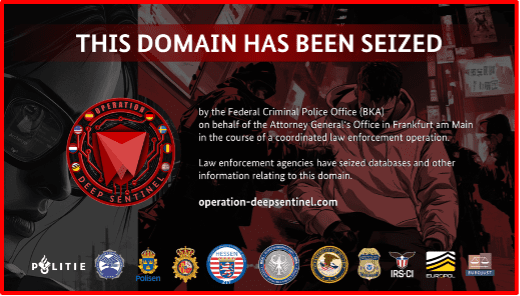
Archetyp Market – In June 2025, law enforcement agencies across Europe dismantled “Archetyp Market”. At the time, the market had obtained over 600K users and boasted a total transaction volume of 250 million euros. The operation, titled Deep Sentinel, unfolded over several years with investigators tracing complex financial flows and conducting extensive digital forensic analysis. More than 300 officers from Germany, the Netherlands, Romania, Spain, and Sweden coordinated efforts to dismantle the network and targeted platform administrators, moderators, key vendors, and the underlying technical infrastructure.
By combining cyber expertise, undercover operations, and partnerships, law enforcement continues to evolve its playbook to disrupt dark web marketplaces. While these shutdowns don’t eliminate the activity entirely, they create a chain reaction undermining trust in major platforms and making vendors and buyers more cautious about where and with whom they do business.
Tactics
Over the course of law enforcement’s fight against dark web marketplaces, agencies have developed and evolved an arsenal of tools and strategies to discover and dismantle the operations. Below are a few commonly used practices used in major marketplace takedowns and seizures.
Undercover Operations – In some instances of dark web marketplace takedowns, agencies will take over a market by pretending to be an administrator.In 2017, Dutch authorities operated the Hansa marketplace for approximately one month, enabling them to identify and track user information. Similar tactics have been employed by the FBI, which has previously infiltrated marketplaces and conducted small purchases to collect intelligence on sellers and administrators.
Blockchain forensics – Using blockchain forensics/intelligence, investigators are able to follow the flow of digital assets and can identify wallets that cybercriminals use to store illegal funds. This tactic has been employed in multiple dark web marketplace seizures (Silk Road, Hydra) by providing investigators with a means to identify those operating the site. Once thought to be untraceable, the process has frequently enabled the identification of cryptocurrency transactions.
Network Investigative Techniques (NITs) – In previous marketplace seizure cases, the FBI has used NITs to discover users IP or identity. These operations are authorized via a warrant and use malware or exploits to extract information from users and administrators active in the marketplace. As demonstrated in numerous cases, NITs are routinely used by law enforcement and have drawn scrutiny over the scope of data they are able to collect.
As new dark web marketplaces emerge and expand, law enforcement has adapted by developing more advanced and impactful investigative methods. Techniques such as the use of Network Investigative Techniques (NITs) have proven effective, though they remain controversial. Privacy advocates continue to raise concerns about these tactics, but as authorities refine and expand their capabilities, challenging their use may become increasingly difficult.
Conclusion
Previous law enforcement operations have demonstrated that no marketplace is beyond reach. As the mentioned cases illustrate, buyers and sellers on the dark web are not truly anonymous. Each major shutdown has resulted in numerous arrests and the seizure of millions of dollars. While these take downs have been successful, they have not curbed the creation of new marketplaces. Following the shutdown of Hydra, dark web marketplaces rebounded, and revenue climbed to $1.7 billion. Although the fight remains an uphill battle, law enforcement agencies around the world have successfully taken down several high-profile marketplaces, creating significant disruptions across the cybercriminal ecosystem.
DarkOwl has previously covered several of the aforementioned markets. Check out our blogs on Hydra and Archetyp.


