Things That Go Bump in the Dark Web: 2026’s Scariest Threat Trends
October 30, 2026

Introduction
Haunted houses close on the first of November. The dark web does not. While most of us are carving pumpkins, threat actors are trading stolen logins, rebranding ransomware crews, and selling AI-generated faces by the thousands.
At DarkOwl, our analysts spend every day in the parts of the internet most people never visit. So, this Halloween, we’re counting down the five threats from 2026 that kept us up at night. Grab a torch. It gets dark from here.
Zombie Credentials: the Logins that Won’t Stay Dead
You changed your password years ago. Your old credentials are still out there. Infostealer logs keep feeding stolen logins back into criminal markets, where they are bundled, resold and repackaged into combolists again and again.
The numbers are grim. KELA tracked 2.86 billion compromised credentials circulating in criminal markets in 2025, and Constella processed 51.7 million infostealer packages that year, up 72%.
What makes these zombies dangerous isn’t the password alone. A single log can hold:
- Saved browser passwords
- Session cookies that can skip MFA entirely
- Autofill data, including addresses and card details
- Crypto wallet files and seed phrases
The infection-to-sale window is fast. Logs are tested against live services within a day and listed on markets such as Russian Market within 48 hours. Corporate VPN or identity-provider access can sell for $100–$500.
Why it’s scary: one infected personal laptop can hand an attacker a valid session into your corporate SSO. No break-in required, just a login.
The Shapeshifters: Ransomware that Changes Its Face
Kill one ransomware brand and two more crawl out of the grave. 2026 has been the year of splintering: fewer giants, many more small crews, and affiliates switching between them as easily as changing costumes.
Black Kite counted 146 active ransomware groups by June 2026, more than double its 2023 figure, with 61 new groups in 12 months. Some brands barely last a season. Vect appeared in January 2026, and its leak site was offline by mid-April.
The shapeshifting is often driven by the affiliates themselves:
- The Gentlemen reportedly grew out of a former Qilin affiliate after a commission dispute, and Unit 42 credited it with 580 claimed victims across 77 countries by July 2026.
- Global Secret Group surfaced in mid-2026 using leaked LockBit 3.0 code.
- Data-theft-only crews skip encryption altogether and go straight to extortion.
Why it’s scary: a new name doesn’t mean new people. Defenders who track brands instead of actors, tools and infrastructure will always be one costume behind.
The Masks: Deepfakes for Hire
The scariest mask this year isn’t on a trick-or-treater. It’s a real-time synthetic face sold to defeat identity checks.
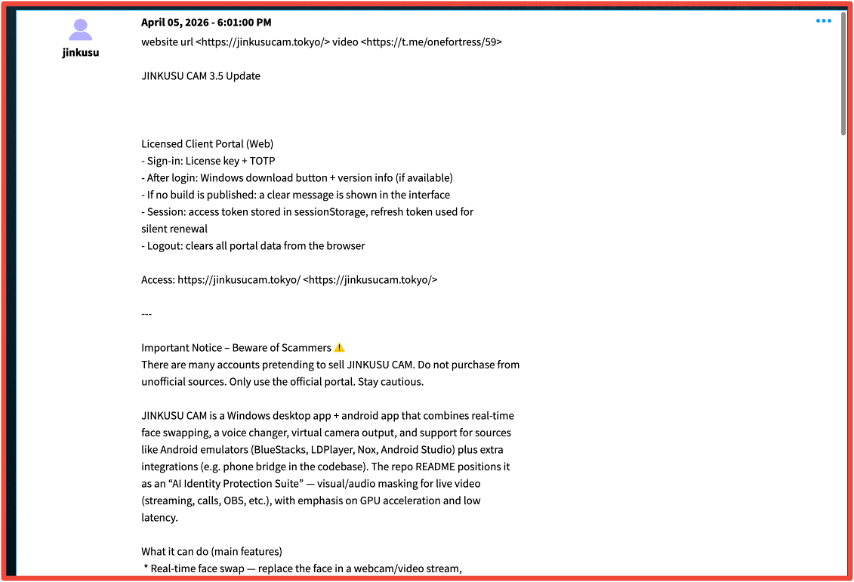
In April 2026, a threat actor on DarkForums advertised a darknet kit called JINKUSU CAM, reportedly offered for around $15 per KYC bypass attempt. The kit reportedly:
- Swaps a donor face onto a live video stream in real time
- Feeds that stream through a virtual camera, so verification platforms see a “real” webcam
- Adds voice modulation to match
- Ships with presets for major crypto exchanges
Pair these tools with the identity data from stealer logs and “fullz” bundles, and you get synthetic identities that can open accounts, pass checks and launder funds at scale.
Why it’s scary: “seeing is believing” no longer works. A face on a video call or a selfie check is now something you can buy for less than the price of a Halloween costume.
The Haunted Messenger: Telegram’s Undying Channels
Telegram has been swinging the axe, but the channels keep coming back like a slasher who’s always “definitely dead this time”.
Check Point reports that Telegram blocked more than 43.5 million channels and groups in 2025, with daily takedowns rising to 80,000–140,000 and peaking above 500,000. Yet criminals have adapted:
- Backup channels are set up before a ban, with audiences preloaded
- “Request to Join” gates keep moderation bots out
- Forwarded messages carry content from blocked channels into new ones
And they aren’t really leaving. Over three months, Check Point found about 3 million Telegram invite links shared underground, while Discord made up under 6% of that volume. One group that moved to SimpleX returned to Telegram when its followers didn’t follow.
Why it’s scary: takedowns change how threat actors operate, not where. Monitoring has to follow the resurrections, not just the original channel.
The Call is Coming from Inside the House: SaaS and Identity Breaches
Our number one scare is the classic horror twist: the threat is already inside. In 2026, many of the biggest data thefts didn’t involve breaking down the front door. Attackers logged in.
The pattern is consistent. Threat actors compromise identity access through vishing, session hijacking or MFA fatigue against single sign-on, then move into SaaS tenants such as Microsoft 365, Google Workspace and Salesforce to export data. In early 2026, data tied to around 14 million Panera Bread customers was reportedly advertised on criminal forums, with a threat actor linking it to ShinyHunters.
This is where every monster on our list meets. Stolen session cookies (zombies) open the door, deepfaked voices and faces (masks) talk past the help desk, Telegram channels (haunted messengers) advertise the data, and extortion crews (shapeshifters) collect.
Why it’s scary: your perimeter is now every vendor, every SaaS app and every login. If one of them is compromised, your data walks out wearing a valid badge.
Turning the Lights On
Every horror film has the moment someone finally flips the switch. With the dark web, visibility is that switch. You can’t stop threats you can’t see, but you can see a lot more than most organizations realize.
A few practical ways to keep the monsters at bay:
- Monitor for exposed credentials and sessions. Watch stealer logs and combolists for your domains, and invalidate sessions as well as passwords.
- Track actors, not just brands. Follow the handles, tooling and infrastructure behind ransomware names so rebrands don’t catch you off guard.
- Harden identity checks. Treat video and selfie verification as one signal among several, and train help desks to spot social engineering.
- Watch the chatter. Monitor Telegram and forums for mentions of your brand, executives and vendors, including the backup channels.
- Map your SaaS and third-party exposure. Know which vendors hold your data and watch for them in leak listings.
DarkOwl gives security teams that light. Our data covers the darknet, deep web, Telegram and other high-risk platforms, so you can spot exposure early and act before the scare becomes a breach.
Happy Halloween from all of us at DarkOwl. Stay safe out there.


