Cyber Security Awareness Month: Upcoming Content
October 01, 2026
In light of Cybersecurity Awareness month, DarkOwl is committed to sharing research, trends and industry news from our analysts.
Be the first to know as we release new research by entering your email below!
Upcoming Content This Month
BLOG
Threat Intel Round Up: September
Our analyst team shares a few articles each week in our email newsletter which goes every Thursday. Make sure to register! This blog highlights those articles in order of what was the most popular in our newsletter – what our readers found the most intriguing. Stay tuned for a recap every month. We hope sharing these resources and news articles emphasizes the importance of cybersecurity and sheds light on the latest in threat intelligence.
EVENT
NPCC Innovation & Digital Summit
DarkOwl’s Regional Director and Co-Founder of the UK OSINT Foundation will be at the NPCC Innovation & Digital Summit in Liverpool, England. It is the UK’s main policing technology conference and brings together senior digital, data and technology leaders from the police forces of England and Wales, along with government, academia and technology companies. Use the link below to schedule a time to meet and learn more about DarkOwl. Meet us!
EVENT
it-sa Expo & Congress
We will be at it-sa 365, Europe’s largest trade fair for IT security and one of the most important dialogue platforms for IT security solutions. The trade fair in Nuremberg, Germany covers the entire range of products and services in the field of cybersecurity: hardware, software, training and consulting services as well as Security as a Service. Stop by and meet with us at Booth 9 – 223. Meet us!
BLOG
GDPR and Dark Web Investigations: When European Subjects Show Up in Breach Data

An analyst pulls a stealer-log dataset while tracking a threat actor’s infrastructure. Buried in the rows: credentials, device fingerprints, and email addresses belonging to residents of France, Germany, and the UK. The investigation was never framed as a “European” matter — but at this point, GDPR is very likely already in play.
For US-based OSINT and dark web investigation firms, this is a common blind spot. GDPR exposure isn’t about where a firm is incorporated or where its servers sit. It’s about whose data ends up in the workflow, and why.
BLOG
Malware as a Service
Cybersecurity might as well have its own language. There are so many acronyms, terms, and sayings that unless you are deeply knowledgeable, have experience in the security field, or have a keen interest, one may not know what they mean. Understanding these terms is the first step to developing a thorough understanding of cybersecurity and, in turn, better protecting yourself, clients, and employees.
In this blog series, we aim to explain and simplify some of the most commonly used terms. Previously, we have covered bullet proof hosting, CVEs, APIs, brute force attacks, zero-day exploits, doxing, data harvesting, IoCs, credential stuffing, ransomware as a service, push bombing, web application attacks, man-in-the-middle attacks, ransomware leak sites, and the CIA Triad. In this edition, we will dive into malware as a service.
BLOG
Q3 Product Updates
Stay tuned for our quarterly update blog highlighting new product features and collection stats updates. There is always something exciting coming from our Product and Collections teams and the team is excited to share this round of updates!
BLOG
AI Is Rewriting the Ransomware Playbook

Artificial intelligence is reshaping cybersecurity on both sides of the battlefield. While organizations are increasingly adopting AI to strengthen their defenses, cybercriminals are using the same technology to launch faster, more sophisticated ransomware attacks that outpace traditional security measures. According to CrowdStrike’s 2025 State of Ransomware Survey, 76% of organizations say they struggle to keep up with AI-powered threats, and nearly 90% believe AI-driven protection is now essential.
According to the Global Cybersecurity Outlook 2026 survey, 87% of respondents identified AI-related vulnerabilities as the fastest-growing cyber risk in 2025. Looking ahead, data leaks associated with generative AI (34%) and the advancement of adversarial capabilities (29%) are the leading concerns for 2026. This represents a notable shift from 2025, when adversarial capabilities ranked first at 47%, compared with just 22% for genAI-related data leaks. The change signals a turning point in the AI risk landscape: while the AI arms race between attackers and defenders continues, growing attention is shifting from offensive AI capabilities toward the unintended exposure and misuse of sensitive data through generative and agentic systems.
BLOG
Cyber Hygiene at Work & Home
In this blog, we will highlight best practices for a safer digital life.
WEBINAR TRANSCRIPTION
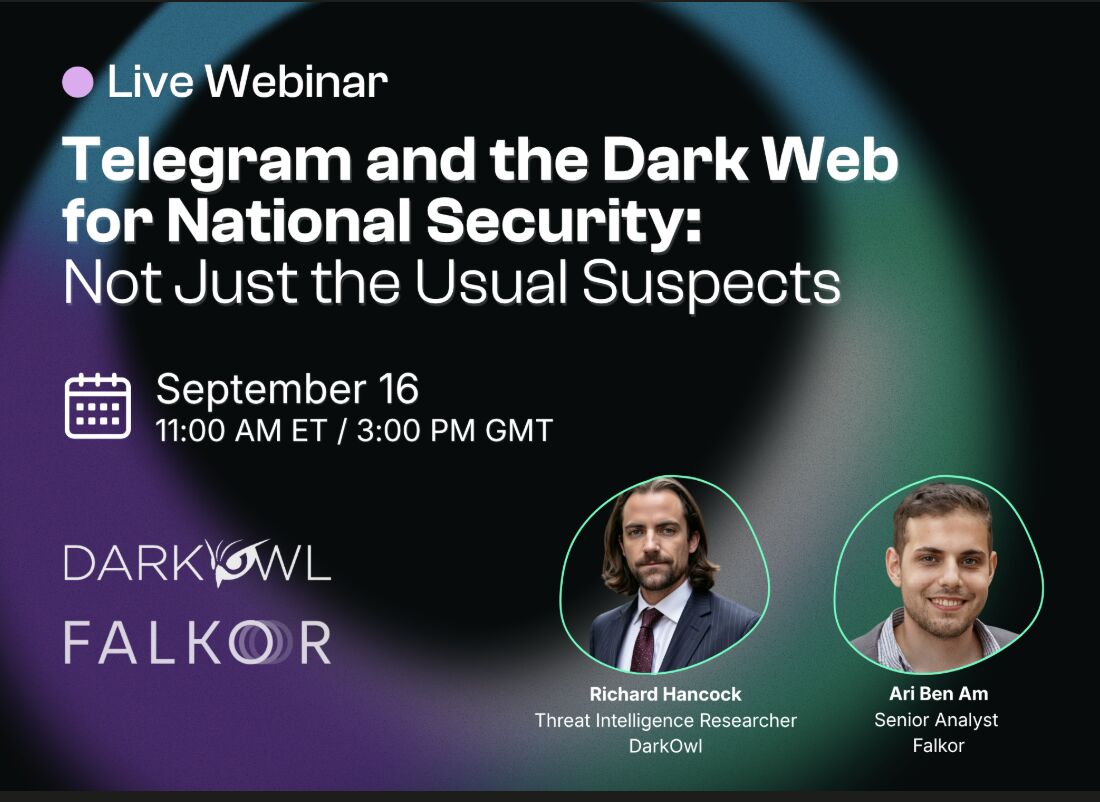
Telegram and the Dark Web for National Security: Not Just the Usual Suspects
Telegram and the dark web are no longer just cybercrime spaces. They are key channels for national security threats, including terrorism, espionage, geopolitical activity, and criminal networks. In this webinar, Falkor and DarkOwl explored how investigators can use Telegram and dark web sources to uncover hidden activity, follow hard-to-track networks, and build stronger investigations beyond the usual cybercrime lens.
BLOG
OWASP 101
Cybersecurity might as well have its own language. There are so many acronyms, terms, and sayings that unless you are deeply knowledgeable, have experience in the security field, or have a keen interest, one may not know what they mean. Understanding these terms is the first step to developing a thorough understanding of cybersecurity and, in turn, better protecting yourself, clients, and employees.
In this blog series, we aim to explain and simplify some of the most commonly used terms. Previously, we have covered bullet proof hosting, CVEs, APIs, brute force attacks, zero-day exploits, doxing, data harvesting, IoCs, credential stuffing, ransomware as a service, push bombing, web application attacks, man-in-the-middle attacks, ransomware leak sites, and the CIA Triad. In this edition, we will dive into OWASP.
BLOG
Halloween: Spooky Finds on the Dark Web
The darknet can be a scary place. 👻 For Halloween, we will highlight some spooky findings from our analyst team that they have come across this past year. In the meantime, check out our previous edition where the team uncovered human organs for sale, human meat for sale, and hitmen for hire! Check out our other holiday editions here and here.
Curious to see how darknet data can improve your cybersecurity situational awareness? Contact us.


